
Whose Faith Actually Saves?
What if the question most commonly asked concerning salvation begins from an assumption the Scriptures never establish? What if asking whether an individual has enough faith has caused us to overlook whose faith is actually operating?
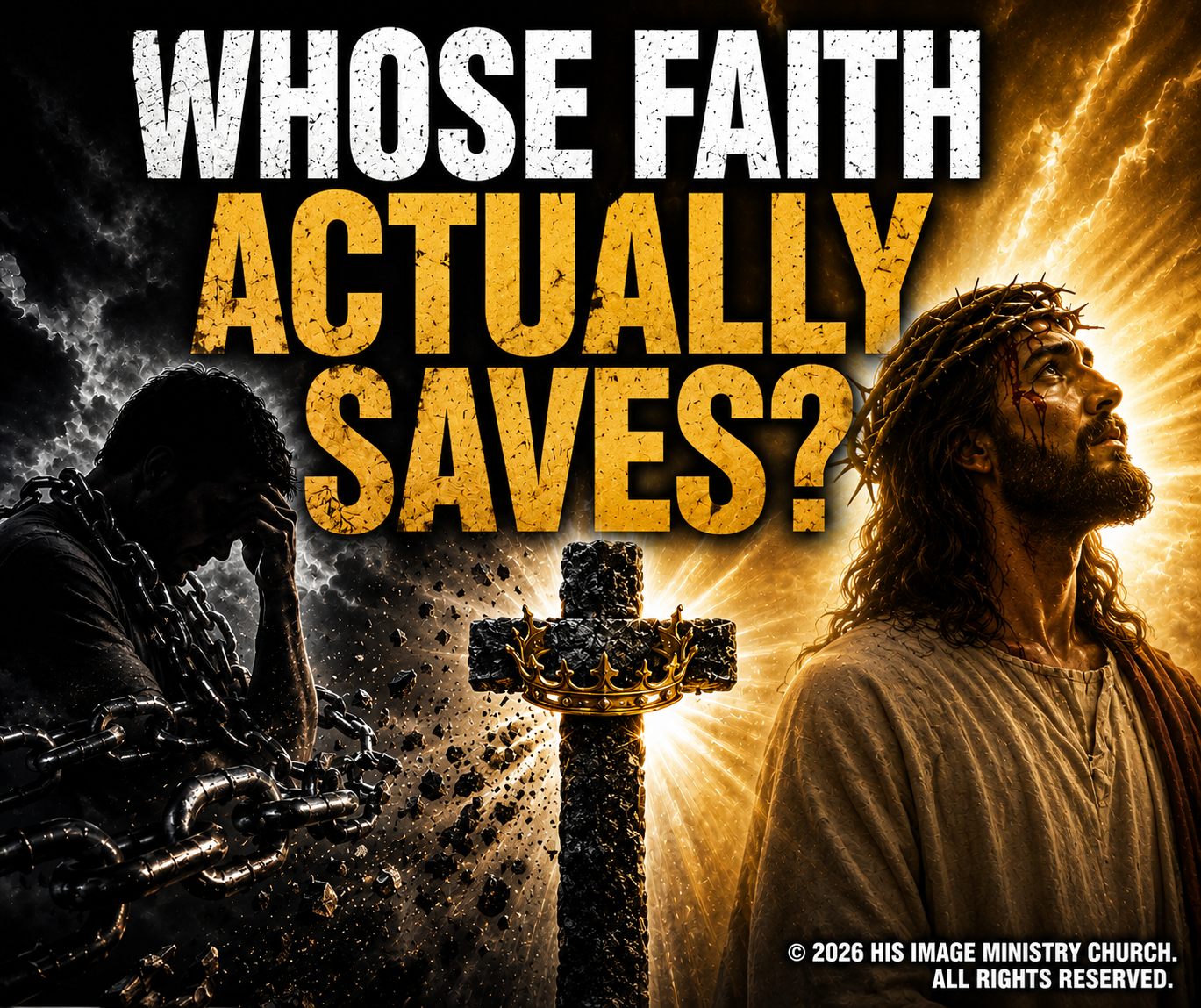
If Salvation Is Not Out of You, Why Is Your Faith Treated as the Final Requirement?
By George Maitland of His Image Ministry Church
What if the question most commonly asked concerning salvation begins from an assumption the Scriptures never establish? What if asking whether an individual has enough faith in God has caused us to overlook the more fundamental question of whose faith is actually operating? Christianity has repeated for generations that Jesus Christ accomplished everything necessary for salvation, yet it has also insisted that none of what He accomplished becomes effective for an individual until that individual supplies the final requirement of personal faith. But if the individual must originate the faith that makes salvation effective, can salvation truly be said to be "not out of you"? If Jesus Christ completed salvation, what remains for the one being saved to complete? And if human faith is the final element that changes Jesus Christ from a potential Savior into an actual Savior, whose operation ultimately determines whether salvation succeeds?
Perhaps the contradiction has remained hidden because the word "faith" is used so broadly that its source is rarely identified. We speak of the faithfulness of God, the faith of God, the faith of Jesus Christ, the faith within the believer, the act of believing, covenantal faithfulness, kingdom faith, and the faith as the truth entrusted to the ecclesia. Yet these expressions are often treated as though they refer to several independently originating faiths. God has His faith. Jesus Christ has another faith. The believer generates a third faith. Salvation is then explained as the result of these separate faiths cooperating with one another, God supplying His part, Jesus Christ supplying His part, and the individual supplying the final part that makes the whole operation effective.
But is that what the Scriptures reveal?
What if there are not several independent sources of saving faith? What if there is one absolute Source, God Himself, whose faithfulness moves through His Word, becomes perfectly embodied and accomplished in Jesus Christ, is conveyed through the declaration concerning Christ, is unveiled by the Spirit, and becomes relatively operative within human consciousness as believing? What if the faith experienced within us is truly ours in consciousness and expression, but never ours as its ontological origin?
We hear. We become persuaded. We believe. We trust. We confess. We stand. We walk. We endure. These movements are genuinely experienced within us, but the experience of faith within our consciousness does not prove that we originated the faith. A lamp truly shines, yet the lamp does not become the source of the electricity operating through it. A branch truly bears fruit, yet the branch does not become the source of the life flowing through the vine. In the same manner, we truly believe, but the fact that faith is experienced within us does not mean that faith is out of us.
Paul writes, "Consequently, faith is out of tidings, yet the tidings through a declaration of Christ" [Romans 10:17, CLV]. Faith is out of the tidings. It does not originate independently within the hearer and then attach itself to the declaration. The declaration is not placed before a neutral human faculty that must manufacture faith from itself. The declaration concerning Christ carries the faith by which that declaration is recognized. When God gives hearing, the faith contained in what He has spoken becomes operative within the one who hears.
This is why the question, "Do you have faith?" remains incomplete. What faith? From where did it come? Is it a spiritual possession generated independently by the individual, or is it the faith of God becoming relatively conscious and expressive within that person? Is God responding to something originating in humanity, or is humanity responding because something originating in God has entered the consciousness through His Word?
The faithfulness of God must remain the absolute beginning. God does not exercise faith because He is uncertain. He does not believe something because He lacks knowledge. He does not trust in the hope that His purpose may succeed. The faithfulness of God is His unchanging fidelity to Himself, His Word, His declarations, and His intention. He cannot deny Himself [2 Timothy 2:13, CLV]. What He purposes, He possesses the wisdom and power to accomplish.
When Scripture speaks of faith of God, the language should not cause us to imagine God believing as an uncertain creature believes. Faith of God is faith proceeding from divine certainty, purpose, authority, and fidelity. It is the faith that is out of God, governed by God, and expressive of what God has declared. When that faith becomes operative in the creature, it becomes relative to the creature's consciousness and function, but it never ceases to be out of God in its origin.
This means that what we call "our faith" must be understood carefully. It is ours relatively because we are conscious of believing. It becomes our persuasion, our confession, our trust, our walk, and our faithfulness. Yet it is not ours absolutely, as though an independent self produced faith and presented it to God. What appears within us as our faith is the faith of God reaching us through His Word, perfectly demonstrated through Jesus Christ, unveiled by the Spirit, and expressed according to our placement and administration.
Only when this order is established can we begin to ask whose faith actually saves.
Before Abraham Believed, God Had Already Spoken
Paul reaches back to Abraham when he unfolds righteousness through faith. He does not begin with Sinai, the legislation, the Levitical priesthood, or Israel's national covenant. He returns to Abraham before circumcision and centuries before the law. The distinction must be stated precisely. Abram had already been identified as the Hebrew in Genesis 14:13. The significant point is not that he believed before he was called a Hebrew, but that his believing was reckoned for righteousness before circumcision became the covenantal sign and before Israel existed as a nation under the law.
Why does Paul return to that moment?
Could it be because Abraham allows us to observe faith before it becomes surrounded by the later covenantal requirements given to Israel? Abraham stands before God with no law from Sinai, no Levitical priesthood, no tabernacle, no national sacrificial system, and no circumcision yet placed in his flesh. God speaks a promise concerning seed, inheritance, and blessing. Abraham believes God, and his believing is reckoned to him for righteousness [Genesis 15:1-6; Romans 4:1-12, CLV].
But what happened first? Did Abraham produce faith and then use that faith to persuade God to respond, or did God speak the promise through which faith became operative within Abraham? Did Abraham create the future through confidence, or did the declared future of God produce confidence within Abraham? Did Abraham originate the certainty, or did the certainty belonging to the One Who spoke become persuasive within the one who heard?
Before Abraham believed, God had spoken. Before Abraham became persuaded, God had declared. Before faith became conscious within Abraham, the promise, power, intention, and certainty existed absolutely in God. Abraham's believing did not provide God with an ability He lacked. The declaration of God conveyed to Abraham the certainty of God's own ability.
Paul says that Abraham became fully assured that what God had promised, He was able to do also [Romans 4:21, CLV]. That assurance was truly experienced by Abraham, but from where did it come? Was Abraham contemplating a future created out of his own imagination, or was he hearing the Word of God? Was his certainty grounded in the strength of his own inner confidence, or in the ability of the One Who had promised?
The natural evidence present in Abraham's body gave him no reason for confidence. His body had become deadened, and the matrix of Sarah had become deadened. If Abraham measured the promise according to the capacities of the flesh, there was no natural basis for expectation. The promised seed could not be brought forth out of Abraham's strength. The power would have to be out of God.
Would the faith by which Abraham received the promise come from a different source than the power by which the promise would be fulfilled? Could the fulfillment be out of God while the decisive faith remained out of Abraham? Or did the same Word that declared the promise carry within it the faith by which Abraham became persuaded?
Abraham believed, but his believing was not an independent spiritual force operating upon God. It was the faithfulness of God, carried in the promise, becoming conscious and persuasive within Abraham. Abraham did not make God capable. The faith operating within him recognized that God was capable. Abraham did not create the promise. Faith within him received the promise God had created. Abraham did not make God faithful. The faithfulness of God became relatively expressed in Abraham as believing.
This is why Abraham's believing gave glory to God. Faith gives glory to God when the creature does not claim to be the origin of the certainty operating within him. Abraham did not look inward and praise the strength of his own faith. He looked toward the One Who had spoken and became persuaded concerning His ability. The faith within Abraham testified to the faithfulness of God.
Circumcision came afterward as a sign and seal [Romans 4:9-12, CLV]. The sign did not create the righteousness it signified. Nor did circumcision create the faith that had already come through the declaration. The Word came first. Faith came out of the Word. Believing appeared within Abraham's consciousness. Righteousness was reckoned. The covenantal sign followed.
Why is this order so important? Because it reveals that human believing cannot be separated from the prior speaking of God. If God had not spoken, what would Abraham have believed? If God had not declared the promise, from where would faith have come? If God had not communicated His certainty, could Abraham have manufactured divine assurance from his own flesh?
The faith experienced by Abraham was genuinely Abraham's relatively. He believed. He became assured. He glorified God. Yet the faith was not out of Abraham absolutely. It came out of God through the promise and became expressive within Abraham.
The seed of the discovery is already present. Human believing does not originate saving faith. Human believing is what the faith of God looks like when that faith becomes conscious within a human being.
The Covenant and the Exposure of Human Faithfulness
If faith is out of God, why did God later establish Israel under a covenant that required belief, obedience, and faithfulness? Was the covenant designed to prove that Israel possessed an independent capacity for fidelity, or did it reveal the impossibility of the creature becoming the source of the faithfulness required by the purpose of God?
At Sinai, Israel heard the words of Yahweh and agreed to perform all that He had spoken. The nation entered an administration in which blessing, national standing, priestly function, possession of the land, protection from enemies, agricultural abundance, cleansing, and continued enjoyment of the promises were connected to covenantal obedience. Faith within that covenant could not be reduced to an inward opinion concerning the existence of Yahweh. The faith of God, as it became relatively operative in Israel, was expected to appear through trust, worship, obedience, sacrifice, separation, and fidelity to the covenantal order.
The proselyte who joined himself to Israel was not merely accepting a private set of religious ideas. He entered the covenantal identification of the nation. He accepted Israel's God, Israel's sign, Israel's legislation, Israel's worship, and the expectations governing those dwelling among the covenant people. The same law applied to the native and to the sojourner entering that order [Exodus 12:43-49; Numbers 15:14-16, CLV].
The faith of God in that administration was being expressed within a terrestrial and national setting. It concerned a covenant people, a land, a priesthood, a kingdom, harvests, enemies, judgments, exile, restoration, and Israel's appointed place among the nations. When an Israelite believed Yahweh, the faith of Yahweh became relatively visible through obedience to what He had spoken.
Yet what did Israel's history reveal? Did the nation possess a self-sustaining faithfulness capable of securing the covenantal purpose? Did righteous legislation generate within the flesh the faith required for perfect obedience? Did command create capacity, or did the command reveal that the flesh could not become the origin of the faithfulness it was being asked to express?
The law identified the righteous standard, but it did not transform the flesh into the source of righteousness. Through law came the recognition of sin. The nation possessing the oracles, covenants, promises, priesthood, and visible interventions of God could not establish its own righteousness [Romans 3:19-20; 9:1-5, CLV].
Israel's failure did not prove that the faith of God lacked power. It revealed that the creature could not possess divine faith as though that faith had become an autonomous human virtue. Whenever Israel attempted to stand in its own strength, the instability of the flesh became visible. The covenant required faithfulness, but it also exposed that the faithfulness necessary for fulfillment could never originate independently in the covenant people.
Was God surprised by Israel's unbelief? Did the covenant become an experiment through which God discovered the limitations of humanity? Or did the covenant bring into historical manifestation what was already true, that the creature could only express faith relatively and could never become its absolute source?
The covenant did not exist to prove that Israel was faithful. It exposed that Yahweh alone was faithful.
This does not make Israel's believing or obedience unreal. When the faith of God became relatively operative within the people, they believed, obeyed, worshiped, and enjoyed the covenantal blessings. When they resisted the Word and attempted to stand from the flesh, unbelief and disobedience became visible. Judgment, exile, loss, and dispersion followed.
But could Israel's unfaithfulness permanently cancel the faithfulness of God?
Paul asks, "What, then, if some disbelieve? Will not their unbelief nullify the faithfulness of God?" His answer is immediate: "May it not be coming to that! Now let God be true, yet every human a liar" [Romans 3:3-4, CLV].
Paul does not present Israel's faith and God's faith as two independent powers competing for control of the outcome. He places human unbelief beside the faithfulness of God. Israel's unbelief is the failure of the creature to remain in congruence with what God has spoken. It is not a rival power capable of making God unfaithful.
Israel could lose the enjoyment of promises within a generation. Individuals could fail to enter. The nation could experience judgment, exile, and dispersion. Yet Israel could not cause Yahweh to cease being faithful to His ultimate intention. If the unbelief of Israel could permanently defeat the purpose of God, then unbelief would be more absolute than faith. Human resistance would become stronger than divine intention. The creature's inability to express faith would govern the conclusion of the Creator.
The covenant therefore revealed the need for a faithful human expression in which the faith of God would not be resisted, corrupted, or interrupted. If Adam did not remain in obedience, and if Israel could not sustain covenantal fidelity, where would the faith of God become perfectly embodied in humanity?
The expanding circle leads to Jesus Christ.
The Faith of God Perfected in Jesus Christ
When Jesus stood before His disciples after the fig tree had withered, the Concordant rendering speaks of "faith of God" [Mark 11:22, CLV]. This phrase must not be reduced to the idea of individuals manufacturing personal faith and then directing that faith toward God. Nor should it cause us to imagine God believing as an uncertain creature believes. Faith of God is divine certainty, purpose, authority, and fidelity proceeding into relative expression.
What, then, would it mean for the disciples to have faith of God? Would it mean they possessed an independent spiritual force capable of imposing private desires upon creation? Would sufficiently intense confidence compel God to perform whatever they declared? Or would faith of God mean that the faith proceeding from God had become operative within them, bringing their prayer, speech, and action into congruence with divine intention?
The setting remains within Israel and the kingdom proclamation. Jesus is speaking concerning prayer, forgiveness, signs, and authority associated with the kingdom. He is not yet revealing through Paul the secret concerning the joint Body and its celestial allotment. The administrations must not be blended.
Yet the source remains God.
The disciples would believe, speak, pray, and act, but the faith operating through them would not be an autonomous possession originating in the flesh. It would be faith of God, faith proceeding from God, faith aligned with God, and faith expressing the authority of God according to the kingdom purpose.
This prepares the reader to recognize what occurred perfectly in Jesus Christ.
Jesus did not present Himself as an independent source operating beside His Father. He said He could do nothing from Himself [John 5:19, 30, CLV]. His words were not independently originated. His works were the Father's operation through Him [John 14:10, CLV]. He did not come to accomplish a will separate from the One Who sent Him. His food was to do the will of His Father and finish His work.
Whose faith, then, was operative in Jesus Christ?
It was the faith of God in and through Jesus Christ.
That faith became genuinely and personally expressed by Jesus Christ. He believed. He trusted. He obeyed. He endured. He remained faithful unto death. Scripture can therefore properly speak of Jesus Christ's faith. It was His faith relatively because it became conscious, voluntary, obedient, and expressive in Him.
Yet Jesus Christ was not the independent ontological source of a second faith. The Father gave Him the Word. The Father gave Him the command. The Father gave Him the works. The Father gave Him the cup, the purpose, and the authority. Jesus Christ received from the Father without resistance and expressed what He received without corruption.
The faith of Jesus Christ was therefore the faith of God perfectly embodied and perfectly expressed through the Son. It was not another faith standing beside the faith of God. It was the same originating faith of God moving through the perfect human consciousness and obedience of Jesus Christ.
The distinction is relational, not ontological. God is the absolute Source. Jesus Christ is the perfect relative Receiver, Embodiment, Expression, and Accomplisher.
Where Adam resisted, Jesus Christ obeyed. Where Israel failed to sustain covenantal fidelity, Jesus Christ remained faithful. Where the flesh could not fulfill the righteous requirement, God sent His own Son [Romans 8:3-4, CLV].
Jesus Christ did not stand before His Father attempting to generate sufficient faith out of Himself. The Word of the Father carried the faith. The Son received the Word, believed it, lived it, and brought it to full accomplishment. He humbled Himself and became obedient unto death, even the death of the cross [Philippians 2:5-8, CLV].
The faith of God did not remain an invisible divine quality. It became trust, obedience, suffering, sacrifice, death, and victory through Jesus Christ. When Paul speaks of Jesus Christ's faith, he is not introducing another source. He is revealing the faith of God as it reached perfect human accomplishment through the Son.
This becomes decisive in Romans 3.
Paul first removes every possible ground of confidence from humanity. Every mouth is barred. The entire world becomes subject to the just verdict of God. Works of law cannot justify flesh in His sight because law brings the recognition of sin. Only after humanity's inability has been exposed does Paul unveil a righteousness of God apart from law.
Through whose faith is this righteousness manifested?
The Concordant rendering states that it is "through Jesus Christ's faith, for all, and on all who are believing" [Romans 3:22, CLV].
This does not reveal two independent saving faiths. It reveals one faith moving from absolute Source to relative accomplishment and then to relative recognition. The righteousness is of God. God is its Source. The righteousness is manifested through Jesus Christ's faith because the faith of God became perfectly operative and accomplishing in Him. The righteousness is upon those who are believing because the same faith of God, communicated through the evangel and unveiled by the Spirit, becomes relatively operative within those who hear.
Jesus Christ's faith and our believing are not separate contributions joined together to complete salvation. The faith of God in Jesus Christ accomplished. The faith of God in us recognizes the accomplishment. In Jesus Christ, the faith reached obedience unto death. In us, the faith reaches hearing, persuasion, agreement, thanksgiving, and walk. In Him, the faith is accomplishing and foundational. In us, the same originating faith is recognitional and expressive.
The persons differ. The functions differ. The administration and placement differ. The ontological Source does not.
What could our believing add to what the faith of God already accomplished through Jesus Christ? Could the faith now operating within us improve the faith that operated perfectly in Him? Could our later recognition add obedience to His cross? Could our confession make His sacrifice more complete? Could our agreement transform His resurrection from a possibility into a reality?
Our believing does not travel backward through time to complete His obedience. The declaration of His obedience carries the faith by which we now believe.
This is why the conventional explanation must be examined. It is often said that Jesus Christ accomplished salvation objectively, but the individual must make it effective subjectively through personal faith. Yet this language conceals an independent source within the individual. The person is imagined to produce a faith that converts the work of Christ into a personal saving reality.
But if the faith becoming operative within the individual is itself out of God, then the individual is not adding another condition. God is bringing the person into conscious participation in what He already accomplished through Christ.
Believing does not create the saving reality. Believing is the faith of God becoming consciously recognized within the believer.
This does not weaken believing. It reveals the power within believing. Believing is not powerful because it is a human contribution. It is powerful because the faith operating within the human consciousness is of God.
Paul's order remains exact. God is the Justifier. God purposes Jesus Christ as the Propitiatory shelter. God displays His righteousness. The faith of God through Jesus Christ fulfills the obedient work. Justification is gratuitous in God's grace. Boasting is debarred. Those who are believing receive the present recognition and enjoyment of what came through Jesus Christ's faith [Romans 3:21-28, CLV].
What room remains for an independently originating human faith?
Paul asks, "What have you which you did not obtain? Now if you obtained it also, why are you boasting as though not obtaining?" [1 Corinthians 4:7, CLV]. Did the believer obtain faith, or create it? If faith is out of tidings and the tidings come through a declaration of Christ, then faith is not out of the believer. The declaration comes from God. The Spirit unveils the declaration. Faith becomes operative. The believer believes.
All remains out of God, through God, and for God.
The Faith of God Becoming Operative Within Us
Paul does not present the Father as a distant observer watching Jesus Christ attempt to produce sufficient faith from Himself. He declares that God was in Christ, conciliating the world to Himself, not reckoning their offenses to them [2 Corinthians 5:18-21, CLV].
Who initiated the conciliation? God. Where was the faith of God accomplishing that conciliation? In Christ. Through whom did that faith become obedience, suffering, death, and peace? Through Jesus Christ. Who was being conciliated? The world.
Did the faith of the world initiate this action? Did humanity first believe and then cause God to enter Christ? Did enemies manufacture faith and use it to create peace with God?
Paul says Christ died for us while we were still sinners. He says we were conciliated to God through the death of His Son while we were enemies [Romans 5:6-11, CLV]. The conciliation did not begin in human faith. It began in the faithfulness of God, was accomplished through the faith of God in Jesus Christ, and is announced through the evangel so that the same faith may become conscious within us.
What human decision caused Jesus Christ to die? What personal confession roused Him from among the dead? What individual acceptance caused God to cease reckoning offenses through the cross?
God acted before humanity recognized the action. The faith of God reached accomplishment in Jesus Christ before it reached conscious recognition within us.
This does not mean every person presently understands or enjoys conciliation. Many continue walking as enemies in their comprehension. Their minds remain estranged. Their conduct remains opposed to God. This is why the ambassadors of Christ entreat humanity to be conciliated to God.
Yet the entreaty does not ask humanity to create a faith capable of changing God's disposition. The entreaty carries the declaration through which the faith of God becomes operative in the hearer. God's disposition has already been revealed in Christ. The evangel announces what God has done, and within that declaration is the faith by which the hearer recognizes it.
Religion tells the individual to produce faith so that God will become favorable. The evangel declares the favor of God in Christ, and the declaration itself carries the faith by which that favor is recognized. Religion places human faith before divine grace. The evangel places divine grace before and within human believing. Religion says, "Believe so that God may become conciliated." Paul declares that God was in Christ conciliating the world and then heralds that accomplishment so that the faith of God may become operative within human consciousness.
Does salvation begin with humanity directing a faith of its own toward God, or with God communicating His faith through Christ and through the declaration? Does the creature open the heart of God through faith, or does the faith of God open the consciousness of the creature?
If the individual must supply an independent faith before the work of Christ can truly save, then Jesus Christ may have supplied the cross, resurrection, and conciliation, but humanity still supplies the final faith that makes them effective. No matter how small the contribution appears, it remains decisive if it originates outside God.
But if the faith by which the individual believes is also out of God, then salvation remains entirely His operation.
The issue is not the amount contributed. The issue is source.
Paul says, "For in grace, through faith, are you saved, and this is not out of you; it is God's approach present" [Ephesians 2:8, CLV]. What is not out of you? The saving is not out of you. The grace is not out of you. The faith through which the saving becomes conscious and operative is not out of you. The approach is God's. The present is God's. The achievement is God's.
Paul does not divide the sentence so that grace is out of God while faith is out of the individual. Such a division would return humanity to the saving cause. Faith is part of God's approach present. God does not merely approach with information and then wait for humanity to produce faith. His approach communicates the faith by which His grace is known.
Paul describes humanity as dead to offenses and sins. What does a dead person contribute to vivification? Does the dead first manufacture faith and use it to persuade God to make him alive, or does God, being rich in mercy because of His vast love, vivify together in Christ?
The familiar analogy of accepting a gift often fails at this point. A gift analogy ordinarily begins with two living people. One extends an object, and the other decides whether to receive it. Paul begins with God and the dead.
Can the dead create faith before being made alive? Can the dead originate the spiritual capacity necessary to receive life? Or does vivification itself bring hearing, recognition, and believing?
Paul says God vivifies. God rouses. God seats. God saves in grace through faith. This is not out of us. We are His achievement [Ephesians 2:1-10, CLV].
Could God's achievement depend upon faith manufactured by the one being created? Could the old humanity supply the one missing spiritual substance required to complete its creation in Christ Jesus?
Scripture repeatedly returns faith to God's operation. Believing is graciously granted [Philippians 1:29, CLV]. God parts the measure of faith [Romans 12:3, CLV]. Faith is out of tidings, and the tidings come through a declaration of Christ [Romans 10:17, CLV]. Faithfulness appears as fruit of the Spirit [Galatians 5:22, CLV]. God operates in us both to will and to work for the sake of His delight [Philippians 2:13, CLV].
At every point, the faith becoming conscious within us is sustained by something coming from God: the Word, the declaration, the calling, the gracious grant, the measure, the Spirit, the unveiling, and the operation.
Why, then, do we continue treating human faith as the one spiritual substance God does not supply?
God's approach present does not provide a possibility and then withdraw until humanity supplies faith. God approaches in favor. He declares. He gives hearing. He unveils. He vivifies. He grants believing. He brings the creature into conscious agreement with what He accomplished through Christ.
What appears as our faith is truly operative in us, but it is not independently ours. It is ours relatively. It is the faith of God becoming conscious and expressive within our human experience.
The believer truly believes, but the believer does not originate the faith. This does not eliminate the human response. It reveals the glory of the response. Humanity was never designed to exist as an independent source. The glory of the creature is not found in generating something God lacks. The glory of the creature is found in becoming the vessel, expression, and manifestation of what is out of God.
The glory of Jesus Christ was revealed in perfect dependence upon His Father. The glory of the ecclesia is revealed in dependence upon its Head. The glory of believing is that the faith of God has come to conscious expression within us.
How does this occur?
The Spirit reveals the things graciously given to us by God. The Spirit testifies together with our spirit. The Spirit leads, aids, searches, unveils, and produces fruit [Romans 8:14-27; 1 Corinthians 2:9-16; Galatians 5:22-23, CLV].
The Spirit does not introduce a second faith beside the faith of God in Christ. He brings that faith into relative operation within us. He does not testify that we independently produced enough faith to save ourselves. He testifies concerning our placement in Christ, our sonship, righteousness, peace, allotment, and the faithfulness of God expressed through Jesus Christ.
The declaration is heard. The Spirit unveils its truth. The faith carried within the declaration becomes operative. We become persuaded. We believe. We confess. We give thanks. We walk.
The order matters.
God is not responding to a faith originating in us. We are responding because the faith of God has become operative in us.
What we experience as growth in faith is not an autonomous human possession enlarging independently. It is the faith of God being unveiled more fully within us. The Word becomes more deeply established. The inward man comes into greater congruence with the declaration. Assurance, love, endurance, obedience, and maturity increase because the faith of God is being expressed with less resistance and greater recognition.
Our believing is real. Our faithfulness is real. Our obedience is real. Yet all are relative expressions. God remains the Source. Jesus Christ remains the perfect Accomplisher. The Spirit remains the One making the accomplished faith operative within us.
We do not become God's achievement because we independently produce faithfulness. We express faithfulness because we are His achievement and because His faith is operating within us.
The order governs the meaning. The faithfulness of God first. The faith of God in Jesus Christ accomplishing salvation. The declaration of Christ communicating the faith. The Spirit unveiling the faith within us. Our believing as the conscious recognition of that faith. Our faithfulness as the fruit and walk of that faith.
Reverse the order, and humanity becomes the source. Preserve the order, and every expression returns glory to God.
The Same Source, Differing Administrations
Does the faith of God have exactly the same relative expression in every administration? It cannot, because the faith of God comes through the particular revelation, promise, calling, and sphere God has given.
The Source remains the same. The faithfulness of God remains absolute. Faith never becomes an independent human creation. Yet its relative expression differs according to what God is revealing and accomplishing.
In Abraham, the faith of God came through promise. Abraham heard the promise, and that faith became operative within him as persuasion concerning God's ability.
Under Israel's covenant, the faith of God came through the words, statutes, promises, and covenantal order given through Moses. When that faith became relatively expressed in Israel, it appeared as trust, obedience, worship, sacrifice, and fidelity to Yahweh.
In the kingdom proclamation, the faith of God comes through the declaration concerning the King and the nearness of His terrestrial reign. It becomes relatively expressed as repentance, trust, loyalty, obedience, endurance, and participation in the righteous kingdom order.
In the present administration of grace, the faith of God comes through the evangel concerning Jesus Christ, His death, entombment, resurrection, conciliation, and the righteousness of God through His faith. The Spirit unveils this faith within the members of the Body of Christ, and it becomes relatively expressed as believing, peace, gratitude, love, sonship, celestial expectation, and a walk corresponding to grace.
The administrations differ. The revelations differ. The spheres differ. The allotments differ. The relative expressions of the faith differ. The Source does not.
This is why passages concerning faith cannot be removed from their administration and treated as though each one describes an independent human ability operating identically everywhere. Covenant faith concerns a terrestrial people, land, priesthood, kingdom, and national calling. Kingdom faith concerns trust and loyalty in relation to the visible King and His government. The faith operative in the Body of Christ concerns gratuitous justification, conciliation, grace, joint membership, celestial seating, and the secret of the Christ.
When these distinctions are ignored, a blended human faith is created. Covenant conditions are imported into grace. Kingdom endurance becomes the requirement for celestial placement. Paul's gratuitous justification is placed beneath warnings belonging to Israel's kingdom expectation. The Body is made into covenant Israel, and Israel's terrestrial promises are transferred to a celestial ecclesia.
Then every passage is said to teach that an individual must generate sufficient faith to satisfy God.
But Scripture does not reveal one independent human faith applied to several divine programs. It reveals the faith of God moving through distinct declarations and producing the relative response appropriate to each administration.
This distinction becomes especially necessary when considering the Bride of the Lambkin and the Body of Christ. A bride and a body are not interchangeable figures. A bride stands within a covenantal relationship toward her husband. A body exists in organic union with its head.
The bridal identity belongs to the terrestrial and covenantal purpose associated with Israel and finds its consummate expression in the holy city, new Jerusalem, descending out of heaven from God. The city is presented as the Bride of the Lambkin, prepared and adorned in relation to Him. Its gates, foundations, names, measurements, light, and relationship to the nations connect it to the fulfillment of God's terrestrial purpose [Revelation 19:6-9; 21:1-27, CLV].
The faith of God expressed relatively within the bridal calling concerns covenantal promise, preparation, readiness, kingdom, city, earth, and the nations walking in its light. This expression reveals that God remains faithful to what He declared concerning Israel and the terrestrial kingdom.
The Body of Christ is not described as entering a marriage covenant with Christ. It is described as His complement, joined to Him as Head, created into one new humanity, and blessed with every spiritual blessing among the celestials [Ephesians 1:3, 22-23; 2:13-18, CLV].
The faith of God expressed relatively within the Body concerns gratuitous justification, conciliation, grace, joint membership, celestial seating, and the secret of the Christ. The Body does not possess Israel's covenantal identity, and Israel does not possess the celestial identity of the Body.
Both depend entirely upon the faithfulness of God. Both are fulfilled through Jesus Christ. Both express the same originating faith relatively. Yet they do not express that faith within the same administration, sphere, relationship, or allotment.
The Bride displays the faithfulness of God to His covenantal and terrestrial declarations. The Body displays the transcendent riches of His grace among the celestials. The Bride reveals that God will not abandon what He promised concerning Israel. The Body reveals the wisdom concealed from the eons and later made known through Paul.
The Bride is not the Body. The Body is not Israel. Kingdom faith is not the celestial expression of faith. Covenantal fidelity is not gratuitous justification. The covenants are not the secret.
The same faith of God operates according to different revelations and purposes, and its relative expression within each company must remain within its own administration.
Whose Faith Actually Saves?
We may now return to the question with which we began.
Whose faith actually saves?
Did Abraham generate faith out of himself, or did the faith of God come through the promise and become relatively operative within Abraham as believing? Did Israel possess an autonomous covenantal faith, or was every faithful response within Israel the relative expression of the faith of Yahweh? Did Israel's unbelief nullify the faithfulness of God, or did the covenant expose why only God could remain absolutely faithful?
When Jesus spoke of faith of God, was He directing the disciples toward self-generated confidence, or toward the faith of God becoming operative within them? Did Jesus Christ originate an independent faith beside the faith of His Father, or was the faith of God perfectly embodied, trusted, obeyed, and accomplished through Him?
When Paul speaks of Jesus Christ's faith, is he describing a separate human source, or the faith of God reaching perfect human accomplishment through the Son? When we believe, are we adding another faith to the saving operation, or is the faith of God through Jesus Christ becoming relatively conscious and expressive within us?
Did human faith conciliate God, or was God in Christ conciliating the world while humanity remained estranged? Are we God's achievement, or does God wait for us to manufacture the faith that completes His work? Does our believing save because it originates in us, or does believing occur because the saving faith of God has become operative within us?
The scriptural order becomes clear. The faithfulness of God is the absolute Source. The faith of God is His certainty, fidelity, purpose, and power moving into expression. The faith of God in Jesus Christ is the perfect human embodiment and accomplishment of that faith. Jesus Christ's faith is truly His relatively, but God remains its absolute Source. The cross is the decisive act through which the faith of God became obedient sacrifice. The resurrection is the operation and vindication of God. The evangel is the declaration through which the accomplished faith is communicated. The Spirit is the One Who unveils and makes that faith operative within human consciousness. The faith is the revealed truth carrying the divine operation. Our believing is the relative consciousness and recognition of the faith of God within us. Our faithfulness is the fruit produced as that faith continues expressing itself through us.
There is no independently originating saving faith in humanity.
There is the faith of God. It is perfected in Jesus Christ. It is declared through the evangel. It is unveiled through the Spirit. It becomes relatively ours in consciousness and expression.
This does not weaken believing. It releases believing from a burden it was never designed to carry. Believing was never meant to substitute for the Savior. The faith appearing within us was never meant to complete the cross. It was never meant to persuade God to become gracious. It was never meant to transform an unsuccessful Christ into a successful Savior.
The faith of God through Jesus Christ accomplished salvation. The faith of God within us recognizes that accomplishment.
What we call "our faith" is not another faith alongside His. It is His faith becoming relatively operative within us.
Perhaps, then, the final question is not whether you can produce enough faith to make Jesus Christ successful. Perhaps the question is whether the faith of God has brought you into recognition of the One through Whom that faith accomplished everything the Father intended.
Once this is seen, what remains for boasting? What remains for the anxious measurement of whether the individual possesses enough self-generated faith? What remains for the fear that the entire purpose of God is being held together by the strength of a human grip upon Christ?
The strength of salvation is not measured by the strength of your independent faith in Jesus Christ.
There is no independent saving faith.
The strength of salvation is measured by the faithfulness of God expressed through the faith, obedience, death, resurrection, and life of Jesus Christ.
Your believing does not hold the purpose of God together.
Your believing is the relative witness that the faith of God is operating within you.
The faith is out of Him. The accomplishment is through Him. The recognition is through Him. The expression is for Him.
"For out of Him and through Him and for Him is all: to Him be the glory for the eons! Amen!" [Romans 11:36, CLV].
Scripture References
Genesis 12:1-3; 14:13; 15:1-6; 17:1-14; Exodus 12:43-49; 19:3-8; Numbers 15:14-16; Deuteronomy 7:6-9; 29:1-29; 30:1-10; Isaiah 46:9-11; Jeremiah 31:31-37; Ezekiel 36:22-28; Habakkuk 2:4; Mark 1:14-15; 11:20-26; John 5:19, 30; 6:29, 44, 65; 8:28-29; 12:44-50; 14:10; Romans 1:16-17; 3:1-31; 4:1-25; 5:1-21; 8:1-39; 9:1-24; 10:17; 11:5-36; 12:3; 14:22-23; 1 Corinthians 2:9-16; 3:5-15; 4:7; 12:12-27; 15:1-28, 45-49; 2 Corinthians 5:14-21; Galatians 2:15-21; 3:1-29; 4:1-7; 5:5-6, 22-23; Ephesians 1:3-14; 2:1-22; 3:1-12; 4:1-16; Philippians 1:29; 2:5-13; Colossians 1:15-23; 2 Timothy 2:11-13; Hebrews 3:7-19; 4:1-11; 8:6-13; 10:19-39; 11:1-40; James 2:14-26; 1 Peter 1:3-13; Revelation 19:6-9; 20:1-10; 21:1-27.
© 2026 His Image Ministry Church. All rights reserved.
Explore Topics
Written by
George Maitland
Content creator and writer sharing insights and stories.